Blog Archive
-
▼
2011
(49)
-
▼
May
(33)
- Did you know...?
- Quotes Du Coeur
- Lillian's Kitchen: Asparagus and Eggs
- Meanwhile, across the pond....
- The Victorian X-Files: Mummy Meds and Parties
- A Fashionable Fashion Plate
- For the reenactress! Regency updo tutorial
- 150th Series: Col. Elmer Ellsworth killed
- Did you know...?
- Quotes Du Coeur
- Lillian's Kitchen: Gravy for any meat
- Meanwhile, across the pond....
- 150th Series: North Carolina secedes from the Union
- The Victorian X-Files: Fiji Mermaid
- A Fashionable Fashion Plate
- For the reenactress! Twisted braided bun tutorial
- Did you know...?
- Quotes Du Coeur
- Lillian's Kitchen: Boiled Fowls with Oysters
- The Victorian X-Files: Death Photography
- For the reenactress! Braided bun tutorial
- Did you know...?
- Quotes Du Coeur
- Lillian's Kitchen: Catsup
- Happy Mother's Day!
- Meanwhile, across the pond....
- 150th Series: Arkansas secedes from the Union
- The Victorian X-Files: Seances, Mediums and the Fo...
- A Fashionable Fashion Plate
- For the reenactress! Chignon tutorial
- Did you know...?
- Quotes Du Coeur
- Lillian's Kitchen: Apple Jonathan
-
▼
May
(33)
About Me
- Jessica Jewett
- I'm an author, artist and spiritual intuitive. My professional name is Jessica Jewett, which is taken from my maternal family line and to honor the other author in my family, Sarah Orne Jewett. I have published a Civil War novel and several short stories and articles. I'm deeply involved in paranormal and reincarnation research as well.
Followers
Favorite Blogs
-
America’s Long History of Removing Threats19 hours ago
-
-
-
-
-
-
New Scholarship Demands a Rewrite10 years ago
-
Don't Mess With Tradtion10 years ago
-
-
-
Myths of The 3 Day - Part 114 years ago
-
-
Video from the Half!15 years ago
-
How are ya, Pumpkin?15 years ago
-
-
-
Powered by Blogger.
Showing posts with label abraham lincoln. Show all posts
Tuesday, May 24, 2011
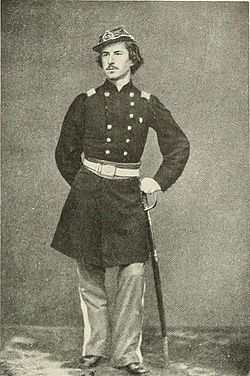
150th Series: Col. Elmer Ellsworth killed
On this day in 1861, Elmer Ellsworth was killed in Alexandria, Virgina, while he was removing a Confederate flag from a window in the Marshall House Inn. He is generally regarded as the first officer killed on duty in the Civil War.
From Wikipedia:
Ellsworth was born in Malta, New York, grew up in Mechanicville, New York, and lived in New York City. In 1854, he moved to Rockford, Illinois, where he worked for a patent agency. In 1859, he became engaged to Carrie Spafford, the daughter of a local industrialist and city leader. Carrie's father demanded that he find more suitable employment, so he moved to Chicago, to study law and work as a law clerk.
In 1860, Ellsworth went to Springfield, Illinois, to work with Abraham Lincoln. He studied law in Lincoln's office and helped Lincoln with his 1860 campaign for president. Ellsworth was only 5' 6" tall, but Lincoln called Ellsworth "the greatest little man I ever met." He accompanied Lincoln to Washington, D.C. in 1861.
Ellsworth became drillmaster of the "Rockford Greys", the local militia company, in 1857. He studied military science in his spare time. After some success with the Greys, he helped train militia units in Milwaukee and Madison. When he moved to Chicago he became colonel of Chicago's National Guard Cadets.
Ellsworth had studied the Zouave soldiers, French colonial troops in Algeria, and was impressed by their reported fighting quality. He outfitted his men in gaudy Zouave-style uniforms, and modeled their drill and training on the Zouaves. Ellsworth's unit eventually became a nationally famous drill team.
The Civil War broke into open warfare in April, and on April 15, 1861, Lincoln called for 75,000 troops to put down rebellion. Ellsworth helped recruit these soldiers: he raised the 11th New York Volunteer Infantry Regiment (the "Fire Zouaves") from New York City's volunteer firefighting companies, and returned to Washington as their colonel.
Ellsworth died shortly after returning to Washington. On May 24, 1861 (the day after Virginia's secession was ratified by referendum), President Lincoln looked out from the White House across the Potomac River, and saw a large Confederate flag prominently displayed over the town of Alexandria, Virginia.
Ellsworth immediately offered to retrieve the flag for Lincoln. He led the 11th New York across the Potomac and into the streets of Alexandria uncontested. He detached some men to take the railroad station, while he led others to secure the telegraph office and get that Confederate flag, which was flying above the Marshall House Inn. Ellsworth and four men went upstairs and cut down the flag. As Ellsworth came downstairs with the flag, the owner, James W. Jackson, killed him with a shotgun blast to the chest. Corporal Francis E. Brownell, of Troy, New York, immediately killed Jackson. Brownell was later awarded a Medal of Honor for his actions.
Lincoln was deeply saddened by his friend's death and ordered an honor guard to bring his friend's body to the White House, where he lay in state in the East Room. Ellsworth was then taken to the City Hall in New York City, where thousands of Union supporters came to see the first man to fall for the Union cause. Ellsworth was then buried in his hometown of Mechanicville, in the Hudson View Cemetery.
Thousands of Union supporters rallied around Ellsworth's cause and enlisted. "Remember Ellsworth" was a patriotic slogan: the 44th New York Volunteer Infantry Regiment called itself the "Ellsworth Avengers", as well as "The People's Ellsworth Regiment."
Relics associated with Ellsworth's death became prized souvenirs. The Smithsonian Institution and Bates College's Special Collections Library have pieces of the Confederate flag that Ellsworth had when he was shot—in 1894, Brownell's widow was offering to sell small pieces of the flag for $10 and $15 each. The New York State Military Museum and Veterans Research Center in Saratoga Springs has most of the flag itself and Ellsworth's uniform, showing the hole from the fatal shot. The Fort Ward Museum in Alexandria dedicates a section of their museum to Ellsworth, displaying the kepi he wore when he was killed, patriotic envelopes bearing his image, a piece of the Confederate Flag (on which Ellsworth's blood is visible), and the "O" from the Marshall House sign that a soldier took as a souvenir.
In 1862, the newly established county seat of Pierce County, Wisconsin, located in the undeveloped center of the county to settle the controversy between two established cities, was named Ellsworth, Wisconsin in his honor.
The 1876 Centennial Exposition in Philadelphia had a major exhibit devoted to Col. Ellsworth.
In addition, Ellsworth, Michigan, Ellsworth, Wisconsin, and Fort Ellsworth were named in his honor.
From Wikipedia:
Ellsworth was born in Malta, New York, grew up in Mechanicville, New York, and lived in New York City. In 1854, he moved to Rockford, Illinois, where he worked for a patent agency. In 1859, he became engaged to Carrie Spafford, the daughter of a local industrialist and city leader. Carrie's father demanded that he find more suitable employment, so he moved to Chicago, to study law and work as a law clerk.
In 1860, Ellsworth went to Springfield, Illinois, to work with Abraham Lincoln. He studied law in Lincoln's office and helped Lincoln with his 1860 campaign for president. Ellsworth was only 5' 6" tall, but Lincoln called Ellsworth "the greatest little man I ever met." He accompanied Lincoln to Washington, D.C. in 1861.
Ellsworth became drillmaster of the "Rockford Greys", the local militia company, in 1857. He studied military science in his spare time. After some success with the Greys, he helped train militia units in Milwaukee and Madison. When he moved to Chicago he became colonel of Chicago's National Guard Cadets.
Ellsworth had studied the Zouave soldiers, French colonial troops in Algeria, and was impressed by their reported fighting quality. He outfitted his men in gaudy Zouave-style uniforms, and modeled their drill and training on the Zouaves. Ellsworth's unit eventually became a nationally famous drill team.
The Civil War broke into open warfare in April, and on April 15, 1861, Lincoln called for 75,000 troops to put down rebellion. Ellsworth helped recruit these soldiers: he raised the 11th New York Volunteer Infantry Regiment (the "Fire Zouaves") from New York City's volunteer firefighting companies, and returned to Washington as their colonel.
Ellsworth died shortly after returning to Washington. On May 24, 1861 (the day after Virginia's secession was ratified by referendum), President Lincoln looked out from the White House across the Potomac River, and saw a large Confederate flag prominently displayed over the town of Alexandria, Virginia.
Ellsworth immediately offered to retrieve the flag for Lincoln. He led the 11th New York across the Potomac and into the streets of Alexandria uncontested. He detached some men to take the railroad station, while he led others to secure the telegraph office and get that Confederate flag, which was flying above the Marshall House Inn. Ellsworth and four men went upstairs and cut down the flag. As Ellsworth came downstairs with the flag, the owner, James W. Jackson, killed him with a shotgun blast to the chest. Corporal Francis E. Brownell, of Troy, New York, immediately killed Jackson. Brownell was later awarded a Medal of Honor for his actions.
Lincoln was deeply saddened by his friend's death and ordered an honor guard to bring his friend's body to the White House, where he lay in state in the East Room. Ellsworth was then taken to the City Hall in New York City, where thousands of Union supporters came to see the first man to fall for the Union cause. Ellsworth was then buried in his hometown of Mechanicville, in the Hudson View Cemetery.
Thousands of Union supporters rallied around Ellsworth's cause and enlisted. "Remember Ellsworth" was a patriotic slogan: the 44th New York Volunteer Infantry Regiment called itself the "Ellsworth Avengers", as well as "The People's Ellsworth Regiment."
Relics associated with Ellsworth's death became prized souvenirs. The Smithsonian Institution and Bates College's Special Collections Library have pieces of the Confederate flag that Ellsworth had when he was shot—in 1894, Brownell's widow was offering to sell small pieces of the flag for $10 and $15 each. The New York State Military Museum and Veterans Research Center in Saratoga Springs has most of the flag itself and Ellsworth's uniform, showing the hole from the fatal shot. The Fort Ward Museum in Alexandria dedicates a section of their museum to Ellsworth, displaying the kepi he wore when he was killed, patriotic envelopes bearing his image, a piece of the Confederate Flag (on which Ellsworth's blood is visible), and the "O" from the Marshall House sign that a soldier took as a souvenir.
In 1862, the newly established county seat of Pierce County, Wisconsin, located in the undeveloped center of the county to settle the controversy between two established cities, was named Ellsworth, Wisconsin in his honor.
The 1876 Centennial Exposition in Philadelphia had a major exhibit devoted to Col. Ellsworth.
In addition, Ellsworth, Michigan, Ellsworth, Wisconsin, and Fort Ellsworth were named in his honor.
Tuesday, April 19, 2011
150th Series: Lincoln orders a blockade
On this day in 1861, President Lincoln formally ordered a blockade on all Southern ports. The war strategy had been planned as a three-pronged approach. The army would strike in the east, and through the western breadbasket of the Confederacy, and the naval blockade would strangle the South into submission. With the blockade in place, trade could not take place with outside nations, nor could the Confederacy be supplied by outside nations. The South depended on imported goods for survival, as well as exporting cotton. The blockade became known as the Anaconda Plan in the way that it resembled a snake on the map strangling the life out of the South. Almost immediately, blockade runners began profiting from the South's desperate need for goods because smaller cargo ships could slip by largely undetected.
Here is Lincoln's order.
Whereas an insurrection against the Government of the United States has broken out in the States of South Carolina, Georgia, Alabama, Florida, Mississippi, Louisiana, and Texas, and the laws of the United States for the collection of the revenue cannot be effectually executed therein comformably to that provision of the Constitution which requires duties to be uniform throughout the United States:
And whereas a combination of persons engaged in such insurrection, have threatened to grant pretended letters of marque to authorize the bearers thereof to commit assaults on the lives, vessels, and property of good citizens of the country lawfully engaged in commerce on the high seas, and in waters of the United States: And whereas an Executive Proclamation has been already issued, requiring the persons engaged in these disorderly proceedings to desist therefrom, calling out a militia force for the purpose of repressing the same, and convening Congress in extraordinary session, to deliberate and determine thereon:
Now, therefore, I, Abraham Lincoln, President of the United States, with a view to the same purposes before mentioned, and to the protection of the public peace, and the lives and property of quiet and orderly citizens pursuing their lawful occupations, until Congress shall have assembled and deliberated on the said unlawful proceedings, or until the same shall ceased, have further deemed it advisable to set on foot a blockade of the ports within the States aforesaid, in pursuance of the laws of the United States, and of the law of Nations, in such case provided. For this purpose a competent force will be posted so as to prevent entrance and exit of vessels from the ports aforesaid. If, therefore, with a view to violate such blockade, a vessel shall approach, or shall attempt to leave either of the said ports, she will be duly warned by the Commander of one of the blockading vessels, who will endorse on her register the fact and date of such warning, and if the same vessel shall again attempt to enter or leave the blockaded port, she will be captured and sent to the nearest convenient port, for such proceedings against her and her cargo as prize, as may be deemed advisable.
And I hereby proclaim and declare that if any person, under the pretended authority of the said States, or under any other pretense, shall molest a vessel of the United States, or the persons or cargo on board of her, such person will be held amenable to the laws of the United States for the prevention and punishment of piracy.
In witness whereof, I have hereunto set my hand, and caused the seal of the United States to be affixed.
Done at the City of Washington, this nineteenth day of April, in the year of our Lord one thousand eight hundred and sixty-one, and of the Independence of the United States the eighty-fifth.
Here is Lincoln's order.
Whereas an insurrection against the Government of the United States has broken out in the States of South Carolina, Georgia, Alabama, Florida, Mississippi, Louisiana, and Texas, and the laws of the United States for the collection of the revenue cannot be effectually executed therein comformably to that provision of the Constitution which requires duties to be uniform throughout the United States:
And whereas a combination of persons engaged in such insurrection, have threatened to grant pretended letters of marque to authorize the bearers thereof to commit assaults on the lives, vessels, and property of good citizens of the country lawfully engaged in commerce on the high seas, and in waters of the United States: And whereas an Executive Proclamation has been already issued, requiring the persons engaged in these disorderly proceedings to desist therefrom, calling out a militia force for the purpose of repressing the same, and convening Congress in extraordinary session, to deliberate and determine thereon:
Now, therefore, I, Abraham Lincoln, President of the United States, with a view to the same purposes before mentioned, and to the protection of the public peace, and the lives and property of quiet and orderly citizens pursuing their lawful occupations, until Congress shall have assembled and deliberated on the said unlawful proceedings, or until the same shall ceased, have further deemed it advisable to set on foot a blockade of the ports within the States aforesaid, in pursuance of the laws of the United States, and of the law of Nations, in such case provided. For this purpose a competent force will be posted so as to prevent entrance and exit of vessels from the ports aforesaid. If, therefore, with a view to violate such blockade, a vessel shall approach, or shall attempt to leave either of the said ports, she will be duly warned by the Commander of one of the blockading vessels, who will endorse on her register the fact and date of such warning, and if the same vessel shall again attempt to enter or leave the blockaded port, she will be captured and sent to the nearest convenient port, for such proceedings against her and her cargo as prize, as may be deemed advisable.
And I hereby proclaim and declare that if any person, under the pretended authority of the said States, or under any other pretense, shall molest a vessel of the United States, or the persons or cargo on board of her, such person will be held amenable to the laws of the United States for the prevention and punishment of piracy.
In witness whereof, I have hereunto set my hand, and caused the seal of the United States to be affixed.
Done at the City of Washington, this nineteenth day of April, in the year of our Lord one thousand eight hundred and sixty-one, and of the Independence of the United States the eighty-fifth.
Subscribe to:
Posts (Atom)