About Me

- Jessica Jewett
- I'm an author, artist and spiritual intuitive. My professional name is Jessica Jewett, which is taken from my maternal family line and to honor the other author in my family, Sarah Orne Jewett. I have published a Civil War novel and several short stories and articles. I'm deeply involved in paranormal and reincarnation research as well.
Favorite Blogs
-
Our Sea Ports2 hours ago
-
-
-
-
-
-
New Scholarship Demands a Rewrite10 years ago
-
Don't Mess With Tradtion10 years ago
-
-
-
Myths of The 3 Day - Part 114 years ago
-
-
Video from the Half!15 years ago
-
How are ya, Pumpkin?15 years ago
-
-
-


Showing posts with label civil war. Show all posts
Showing posts with label civil war. Show all posts
Tuesday, May 24, 2011
150th Series: Col. Elmer Ellsworth killed
 12:00 PM | Posted by
Jessica Jewett |
12:00 PM | Posted by
Jessica Jewett |


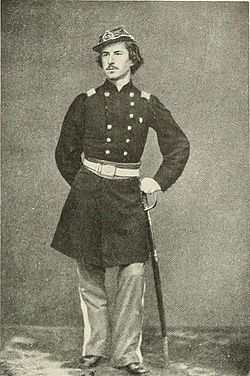
From Wikipedia:
Ellsworth was born in Malta, New York, grew up in Mechanicville, New York, and lived in New York City. In 1854, he moved to Rockford, Illinois, where he worked for a patent agency. In 1859, he became engaged to Carrie Spafford, the daughter of a local industrialist and city leader. Carrie's father demanded that he find more suitable employment, so he moved to Chicago, to study law and work as a law clerk.
In 1860, Ellsworth went to Springfield, Illinois, to work with Abraham Lincoln. He studied law in Lincoln's office and helped Lincoln with his 1860 campaign for president. Ellsworth was only 5' 6" tall, but Lincoln called Ellsworth "the greatest little man I ever met." He accompanied Lincoln to Washington, D.C. in 1861.
Ellsworth became drillmaster of the "Rockford Greys", the local militia company, in 1857. He studied military science in his spare time. After some success with the Greys, he helped train militia units in Milwaukee and Madison. When he moved to Chicago he became colonel of Chicago's National Guard Cadets.
Ellsworth had studied the Zouave soldiers, French colonial troops in Algeria, and was impressed by their reported fighting quality. He outfitted his men in gaudy Zouave-style uniforms, and modeled their drill and training on the Zouaves. Ellsworth's unit eventually became a nationally famous drill team.
The Civil War broke into open warfare in April, and on April 15, 1861, Lincoln called for 75,000 troops to put down rebellion. Ellsworth helped recruit these soldiers: he raised the 11th New York Volunteer Infantry Regiment (the "Fire Zouaves") from New York City's volunteer firefighting companies, and returned to Washington as their colonel.
Ellsworth died shortly after returning to Washington. On May 24, 1861 (the day after Virginia's secession was ratified by referendum), President Lincoln looked out from the White House across the Potomac River, and saw a large Confederate flag prominently displayed over the town of Alexandria, Virginia.
Ellsworth immediately offered to retrieve the flag for Lincoln. He led the 11th New York across the Potomac and into the streets of Alexandria uncontested. He detached some men to take the railroad station, while he led others to secure the telegraph office and get that Confederate flag, which was flying above the Marshall House Inn. Ellsworth and four men went upstairs and cut down the flag. As Ellsworth came downstairs with the flag, the owner, James W. Jackson, killed him with a shotgun blast to the chest. Corporal Francis E. Brownell, of Troy, New York, immediately killed Jackson. Brownell was later awarded a Medal of Honor for his actions.
Lincoln was deeply saddened by his friend's death and ordered an honor guard to bring his friend's body to the White House, where he lay in state in the East Room. Ellsworth was then taken to the City Hall in New York City, where thousands of Union supporters came to see the first man to fall for the Union cause. Ellsworth was then buried in his hometown of Mechanicville, in the Hudson View Cemetery.
Thousands of Union supporters rallied around Ellsworth's cause and enlisted. "Remember Ellsworth" was a patriotic slogan: the 44th New York Volunteer Infantry Regiment called itself the "Ellsworth Avengers", as well as "The People's Ellsworth Regiment."
Relics associated with Ellsworth's death became prized souvenirs. The Smithsonian Institution and Bates College's Special Collections Library have pieces of the Confederate flag that Ellsworth had when he was shot—in 1894, Brownell's widow was offering to sell small pieces of the flag for $10 and $15 each. The New York State Military Museum and Veterans Research Center in Saratoga Springs has most of the flag itself and Ellsworth's uniform, showing the hole from the fatal shot. The Fort Ward Museum in Alexandria dedicates a section of their museum to Ellsworth, displaying the kepi he wore when he was killed, patriotic envelopes bearing his image, a piece of the Confederate Flag (on which Ellsworth's blood is visible), and the "O" from the Marshall House sign that a soldier took as a souvenir.
In 1862, the newly established county seat of Pierce County, Wisconsin, located in the undeveloped center of the county to settle the controversy between two established cities, was named Ellsworth, Wisconsin in his honor.
The 1876 Centennial Exposition in Philadelphia had a major exhibit devoted to Col. Ellsworth.
In addition, Ellsworth, Michigan, Ellsworth, Wisconsin, and Fort Ellsworth were named in his honor.
Friday, May 20, 2011
150th Series: North Carolina secedes from the Union

AN ORDINANCE to dissolve the union between the State of North Carolina and the other States united with her, under the compact of government entitled "The Constitution of the United States."
We, the people of the State of North Carolina in convention assembled, do declare and ordain, and it is hereby declared and ordained, That the ordinance adopted by the State of North Carolina in the convention of 1789, whereby the Constitution of the United States was ratified and adopted, and also all acts and parts of acts of the General Assembly ratifying and adopting amendments to the said Constitution, are hereby repealed, rescinded, and abrogated.
We do further declare and ordain, That the union now subsisting between the State of North Carolina and the other States, under the title of the United States of America, is hereby dissolved, and that the State of North Carolina is in full possession and exercise of all those rights of sovereignty which belong and appertain to a free and independent State.
Done in convention at the city of Raleigh, this the 20th day of May, in the year of our Lord 1861, and in the eighty-fifth year of the independence of said State.
Friday, May 6, 2011
150th Series: Arkansas secedes from the Union

AN ORDINANCE to dissolve the union now existing between the State of Arkansas and the other States united with her under the compact entitled "The Constitution of the United States of America."
Whereas, in addition to the well-founded causes of complaint set forth by this convention, in resolutions adopted on the 11th of March, A.D. 1861, against the sectional party now in power in Washington City, headed by Abraham Lincoln, he has, in the face of resolutions passed by this convention pledging the State of Arkansas to resist to the last extremity any attempt on the part of such power to coerce any State that had seceded from the old Union, proclaimed to the world that war should be waged against such States until they should be compelled to submit to their rule, and large forces to accomplish this have by this same power been called out, and are now being marshaled to carry out this inhuman design; and to longer submit to such rule, or remain in the old Union of the United States, would be disgraceful and ruinous to the State of Arkansas:
Therefore we, the people of the State of Arkansas, in convention assembled, do hereby declare and ordain, and it is hereby declared and ordained, That the "ordinance and acceptance of compact" passed and approved by the General Assembly of the State of Arkansas on the 18th day of October, A.D. 1836, whereby it was by said General Assembly ordained that by virtue of the authority vested in said General Assembly by the provisions of the ordinance adopted by the convention of delegates assembled at Little Rock for the purpose of forming a constitution and system of government for said State, the propositions set forth in "An act supplementary to an act entitled 'An act for the admission of the State of Arkansas into the Union, and to provide for the due execution of the laws of the United States within the same, and for other purposes,'" were freely accepted, ratified, and irrevocably confirmed, articles of compact and union between the State of Arkansas and the United States, and all other laws and every other law and ordinance, whereby the State of Arkansas became a member of the Federal Union, be, and the same are hereby, in all respects and for every purpose herewith consistent, repealed, abrogated, and fully set aside; and the union now subsisting between the State of Arkansas and the other States, under the name of the United States of America, is hereby forever dissolved.
And we do further hereby declare and ordain, That the State of Arkansas hereby resumes to herself all rights and powers heretofore delegated to the Government of the United States of America; that her citizens are absolved from all allegiance to said Government of the United States, and that she is in full possession and exercise of all the rights and sovereignty which appertain to a free and independent State.
We do further ordain and declare, That all rights acquired and vested under the Constitution of the United States of America, or of any act or acts of Congress, or treaty, or under any law of this State, and not incompatible with this ordinance, shall remain in full force and effect, in nowise altered or impaired, and have the same effect as if this ordinance had not been passed.
Adopted and passed in open convention on the 6th day of May, A.D. 1861.
The Victorian X-Files: Seances, Mediums and the Fox Sisters

From Wikipedia:
The Fox sisters were three sisters from New York who played an important role in the creation of Spiritualism, the religious movement. The three sisters were Leah Fox (1814–1890), Margaret Fox (also called Maggie) (1833–1893) and Kate Fox (1837–1892). The two younger sisters used "rappings" to convince their much older sister and others that they were communicating with spirits. Their older sister then took charge of them and managed their careers for some time. They all enjoyed success as mediums for many years.
In 1888 Margaret confessed that their rappings had been a hoax and publicly demonstrated their method. She attempted to recant her confession the next year, but their reputation was ruined and in less than five years they were all dead, with Margaret and Kate dying in abject poverty. Spiritualism continued as if the confessions of the Fox sisters had never happened. "This pattern of confession followed by retraction, which is not uncommon, has supplied both true believers and sceptics with material to support their case, so controversy never ends."
It is no surprise that the desire to communicate with the dead reached a fever pitch during the Civil War due to the high casualties in both the Union and Confederacy. People needed to have their last goodbyes and sought comfort in any way they could. It became highly fashionable to hire mediums to come to gatherings in homes or public venues for this specific purpose. Unfortunately, most of the alleged mediums, like the Fox sisters, were charlatans looking to profit from the grief of others. The fraud has continued into the twentieth and twenty-first centuries and the reputations of legitimate mediums have never fully recovered.
Seances involved people sitting around a table with their eyes closed asking the spirits to communicate through the medium present. Often the alleged medium had the table rigged with different things under tables such as bells with strings that they could pull with their toes, chalkboards on which they could write messages with their toes, and so on. While people's eyes were closed, the clean chalkboard was quickly and quietly switched with the chalkboard containing the message from the great beyond. Tables were also rigged to shake and jerk at the best dramatic moment, which was allegedly a sign from the spirits with the people. The belief in false mediums went to the highest levels of society, including Mary Todd Lincoln, who held seances in the White House after her son died. She also went to a spirit photographer in the years after President Lincoln was killed in order to try and make contact with him.
Spirit photography became immensely popular in the mid-to-late nineteenth century but it was also the most fraudulent practice by these charlatan mediums. It was very easy to accomplish by taking a normal photograph of a living person and then developing it with a double exposure method to impose another image on top of it.
Here are some examples of spirit photography.


Wednesday, April 20, 2011
150th Series: Robert E. Lee resigns from US Army

From Wikipedia:
Lee privately ridiculed the Confederacy in letters in early 1861, denouncing secession as "revolution" and a betrayal of the efforts of the founders. Writing to his son William Fitzhugh, Lee stated, "I can anticipate no greater calamity for the country than a dissolution of the Union." While he was not opposed in principle to secession Lee wanted all peaceful ways of resolving the differences between North and South—such as the Crittenden Compromise—to be tried first, and was one of the few to foresee a long and difficult war.
The commanding general of the Union Army, Winfield Scott, told Lincoln he wanted Lee for a top command. Lee accepted a promotion to colonel on March 28. He had earlier been asked by one of his lieutenants if he intended to fight for the Confederacy or the Union, to which Lee replied, "I shall never bear arms against the Union, but it may be necessary for me to carry a musket in the defense of my native state, Virginia, in which case I shall not prove recreant to my duty." Meanwhile, Lee ignored an offer of command from the CSA. After Lincoln's call for troops to put down the rebellion, it was obvious that Virginia would quickly secede. Lee turned down an April 18 offer by presidential aide Francis P. Blair to command the defense of Washington D.C. as a major general as he feared that the job might require him to invade the South. When Lee asked Scott if he could stay home and not participate in the war, the general replied "I have no place in my army for equivocal men."
Lee resigned from the Army on April 20, and took up command of the Virginia state forces on April 23. While historians have usually called his decision inevitable ("the answer he was born to make", wrote one; another called it a "no-brainer") given the ties to family and state, recent research shows that the choice was a difficult one that Lee made alone, without pressure from friends or family. His daughter Mary Custis was the only one among those close to Lee who favored secession, and wife Mary Anna especially favored the Union, so his decision astounded them. While Lee's immediate family followed him to the Confederacy others, such as cousins and fellow officers Samuel Phillips and John Fitzgerald, remained loyal to the Union, as did 40% of all Virginian officers.
Tuesday, April 19, 2011
150th Series: Lincoln orders a blockade

Here is Lincoln's order.
Whereas an insurrection against the Government of the United States has broken out in the States of South Carolina, Georgia, Alabama, Florida, Mississippi, Louisiana, and Texas, and the laws of the United States for the collection of the revenue cannot be effectually executed therein comformably to that provision of the Constitution which requires duties to be uniform throughout the United States:
And whereas a combination of persons engaged in such insurrection, have threatened to grant pretended letters of marque to authorize the bearers thereof to commit assaults on the lives, vessels, and property of good citizens of the country lawfully engaged in commerce on the high seas, and in waters of the United States: And whereas an Executive Proclamation has been already issued, requiring the persons engaged in these disorderly proceedings to desist therefrom, calling out a militia force for the purpose of repressing the same, and convening Congress in extraordinary session, to deliberate and determine thereon:
Now, therefore, I, Abraham Lincoln, President of the United States, with a view to the same purposes before mentioned, and to the protection of the public peace, and the lives and property of quiet and orderly citizens pursuing their lawful occupations, until Congress shall have assembled and deliberated on the said unlawful proceedings, or until the same shall ceased, have further deemed it advisable to set on foot a blockade of the ports within the States aforesaid, in pursuance of the laws of the United States, and of the law of Nations, in such case provided. For this purpose a competent force will be posted so as to prevent entrance and exit of vessels from the ports aforesaid. If, therefore, with a view to violate such blockade, a vessel shall approach, or shall attempt to leave either of the said ports, she will be duly warned by the Commander of one of the blockading vessels, who will endorse on her register the fact and date of such warning, and if the same vessel shall again attempt to enter or leave the blockaded port, she will be captured and sent to the nearest convenient port, for such proceedings against her and her cargo as prize, as may be deemed advisable.
And I hereby proclaim and declare that if any person, under the pretended authority of the said States, or under any other pretense, shall molest a vessel of the United States, or the persons or cargo on board of her, such person will be held amenable to the laws of the United States for the prevention and punishment of piracy.
In witness whereof, I have hereunto set my hand, and caused the seal of the United States to be affixed.
Done at the City of Washington, this nineteenth day of April, in the year of our Lord one thousand eight hundred and sixty-one, and of the Independence of the United States the eighty-fifth.
 Labels:
150th series,
abraham lincoln,
anaconda plan,
blockade,
blockade running,
civil war,
secession
|
Labels:
150th series,
abraham lincoln,
anaconda plan,
blockade,
blockade running,
civil war,
secession
|
 0
comments
0
comments
Thursday, April 14, 2011
For the reenactress! A matter of hair

Some reenactor sutler companies sell rather sorry looking hair pieces to try and add ready-made buns, length or sausage curls, but they can be spotted from a mile away. They remind tourists that they are looking at make believe rather than feeling immersed in the reenactment or living history. Throughout history, hair has been considered "a woman's crowning glory" which is why they kept it so long. In my opinion, if a reenactress wishes to put her best portrayal out there, she needs to consider all aspects of the nineteenth century woman, not just which dress looks the prettiest. You can have the best, most accurate dress out there, but if you're walking around in a little bob or some other overly sculpted hairstyle, you will always remind tourists that you're just acting. I believe the best portrayals make the tourist believe you fell out of the 1860s. They are more apt to pay attention to what you can teach them.
Today my friend in London was raving about her new hair extensions. I never wanted to try hair extensions before because I don't like the idea of a hair dresser sewing fake hair to my existing hair or using glue or attaching with tracks on my scalp. It all sounded like torture. She posted the how-to video and I watched it in awe at how easy it is and how real it looks. My mind immediately went to reenacting and how these extensions could be used to give ladies instant long hair for their event that can be curled or straight because it is all real hair. If you reenact a lot, it might be worth investing in these extensions. I believe they will greatly improve the quality of your portrayal. They run between $90 and $120, which sounds a bit pricey, but going to the salon to have it done costs a lot more. Some women spend hundreds of dollars on extensions. I believe this is an option worth considering. I'm definitely going to save up my money.
Watch the how-to video.
Tuesday, April 12, 2011
150th Series: In the garish day and in the darkest night
On this day 150 years ago, Fort Sumter fell into Confederate hands. The Civil War began, ushering in four years of blood, fire, death, separation and anguish for all American people. More people were killed in those four years than all other American wars combined to date.
The scale of devastation could not be comprehended by the modern mind. Typically, I use 9/11 as a way to compare. A few thousand people were killed that day and the devastation is still felt today. It was not uncommon for casualties to be in the thousands or tens of thousand in battle after battle. The devastation was relentless and never let up for the entire war. Taking the feelings one experienced in the months surrounding 9/11 and stretching that out into blow after blow for years offers an idea of what this country endured in the Civil War.
It is the individual stories, however, that brings it home for people today. Perhaps the most compelling, famous and gut-wrenching letter of the war was written by Sullivan Ballou. I thought about posting the text of the letter here but it wouldn't have the same affect as hearing it read out loud. Please listen to this man's emotional words and think about what your own ancestors endured in the war.
The scale of devastation could not be comprehended by the modern mind. Typically, I use 9/11 as a way to compare. A few thousand people were killed that day and the devastation is still felt today. It was not uncommon for casualties to be in the thousands or tens of thousand in battle after battle. The devastation was relentless and never let up for the entire war. Taking the feelings one experienced in the months surrounding 9/11 and stretching that out into blow after blow for years offers an idea of what this country endured in the Civil War.
It is the individual stories, however, that brings it home for people today. Perhaps the most compelling, famous and gut-wrenching letter of the war was written by Sullivan Ballou. I thought about posting the text of the letter here but it wouldn't have the same affect as hearing it read out loud. Please listen to this man's emotional words and think about what your own ancestors endured in the war.
Saturday, April 9, 2011
Did you know...?

In July of 1862, when Chamberlain wrote to Maine's Governor Washburn asking for a position in the army, he said: "But, I fear, this war, so costly of blood and treasure, will not cease until the men of the North are willing to leave good positions, and sacrifice the dearest personal interests, to rescue our country from desolation, and defend the national existence against treachery at home and jealousy abroad."
Governor Washburn was a family friend of the Chamberlains, having known both Lawrence's father and grandfather, and he began asking questions about the young professor. Josiah Drummond was the Attorney General at the time and was decidedly against Lawrence being appointed to any position in the army. He wrote to Governor Washburn and said, in part: "Have you appointed Chamberlain Col. Of the 20th? His old classmates etc. here say you have been deceived: that C. is nothing at all: that is the universal expression of those who knew him."
Nevertheless, the governor offered Chamberlain the commission of colonel of the 20th Maine, which Chamberlain declined, saying that he thought he needed to be in a lesser position in order to learn the ways of the army. And so, he was commissioned as lieutenant colonel of the 20th Maine, second-in-command, serving under Colonel Adelbert Ames. As Chamberlain prepared to leave for war, he joined the wave of Maine men applying to become Masons.
During the Civil War years, many Maine men who found themselves on the verge of entering military service were applying in haste for the degrees of Masonry. It is quite probable that they felt it would be helpful to be members of this great Order during their participation in the conflict. The historical records of United Lodge No. 8 in Brunswick reveal that Chamberlain was numbered among this group. We do not know for certain what his primary motivation was to join this great fraternity, but it would seem likely that he had received favorable reports about this ancient institution from colleagues on the Bowdoin faculty who were Masons. The principles of Freemasonry were certainly consistent with the moral principles that guided his life.As a granddaughter and great-granddaughter many times over of many Freemasons, I feel that Joshua Lawrence Chamberlain was a great example of what it meant to be part of the great fraternity.
Because of the pressure being pla ced on lodges to waive the usual waiting period of a month, and the Grand Lodge of Maine's concern that hurry-up work might result in a weakening of the Order at its foundation level, it was decreed that dispensations must be secured and a fee of five dollars charged for a waiver. At a special communication of United Lodge No. 8, held on the evening of August 27, 1862, the secretary presented a dispensation from Grand Master Josiah H. Drumond, to allow Chamberlain to take his Masonic degrees in less than the prescribed time. This, in itself, was somewhat unusual, for dispensations were usually handled by the District Deputy Grand Master. A ballot was taken and Chamberlain was accepted for the Entered Apprentice Degree. While he was being notified of his acceptance and in the process of being brought to the lodge to take the degree, another ballot was taken and it was voted to confer upon him the Fellowcraft Degree. Thus, on that very same night, he was initiated as an Entered Apprentice and passed to the degree of Fellowcraft. At 8:00 a.m. the very next morning, the lodge reconvened and he was raised to the sublime degree of Master Mason. On September 12, 1862, he was proposed as a member, and on October 7, 1862, a ballot was taken and he was officially elected a member of United Lodge.
Within a matter of days, he and the 20th Maine Regiment were off to Washington, arriving there on Sunday, September 7, 1862. *
* "General and Brother Joshua L. Chamberlain: A Mason Who Had the Soul of a Lion and the Heart of a Woman," by Charles W. Plummer, in The Maine Mason, volume 19, number 1, Spring 1991, pages 8-11.
** Thanks to Tom Desjardin for helping me collect the information for this blog.
Friday, April 8, 2011
150th Series: The Beginning

On the left, there is a contemporary painting by Dale Gallon depicting Lieutenant Colonel Joshua Lawrence Chamberlain standing behind his seated wife, Fanny. There is a hint of anxiety in her pose as she fidgets with her wedding ring and holds a handkerchief. Lieutenant Colonel Chamberlain stands tall, as if expecting the war to be the greatest period of his life. This is an entirely accurate representation, in my opinion, of the state of the Chamberlain marriage as the newly commissioned Lieutenant Colonel Chamberlain was preparing to leave civilian life for combat and command.
But we're jumping ahead. He was not commissioned until the summer of 1862 even though President Lincoln's call for volunteers went out in the spring of 1861.
So why did Chamberlain wait so long to volunteer?
In April of 1861, Joshua Lawrence Chamberlain was 32-years-old, turning 33 in September. He had been married to Fanny since 1855 and he had been working as a professor at Bowdoin College since 1856. They had four children in those six years together, although a son died as the result of premature birth in 1857 and a daughter died of scarlet fever in 1860, having not even reached her first birthday. Needless to say, the Chamberlain family was quite young and utterly dependent on him for survival, despite Fanny's premarital offers to continue teaching music to supplement his weak college income. The joy of beginning their family from 1855 - 1861 was quite dampened by the deaths of two children, several of Fanny's relatives, and the tragic death of Lawrence's younger brother, Horace, later on December 7, 1861. So while the young Chamberlain family grew, a dark cloud hung over them at the beginning of the Civil War.
Chamberlain felt the pull to enlist but resisted due to pressure from his family and Bowdoin. His father felt that the rebellion in the South had nothing to do with their life in Maine and began the war from a decidedly antiwar standpoint. His wife had long endured their separations throughout their nearly decade-long relationship and had no interest in sending a husband off to war while she raised their small children alone. As for Bowdoin College, some of the upperclassmen enlisted immediately upon Lincoln's call for 75,000 volunteers and the college itself organized companies like the Bowdoin Guard and the Bowdoin Zuaves. The college fought Chamberlain on his enlistment and dangled a career promotion that he wanted in order to try and keep him in Maine.
And so, as Chamberlain watched the news reports come in of the shots fired at Fort Sumter on April 12, 1861, he remained safely ensconced at home in Brunswick, Maine. He watched 1861 progress from afar, drift into 1862, and he awaited his opportunity to defend his country. In doing so, he knew it would strain his marriage, upset his family, and possibly cost him his job, but he could not ignore his conscience as long as his students were fighting and dying in the field. Eventually, he would get his way....
Wednesday, March 23, 2011
Did you know...?

In the 1850s, Fanny's adoptive father (biologically her cousin) surprised everyone in their family by taking a second wife. His new bride was Helen Root, a young woman only a few months older than Fanny, yet she had to get along with her as her new stepdaughter. Miss Root's older brother was George Root.
From Wikipedia:
He became particularly successful during the American Civil War, as the composer of martial songs such as Tramp! Tramp! Tramp! (The Prisoner's Hope), Just before the Battle, Mother, and The Battle Cry of Freedom. He wrote the first song concerning the war, The First Gun is Fired, only two days after the conflict began with the bombardment of Fort Sumter. He ultimately had at least 35 war-time "hits", ranging in tone from the bellicose to the ethereal. His songs were played and sung at both the home front and the real front. Tramp, Tramp, Tramp became popular on troop marches, and Battle Cry of Freedom became well-known even in England.
Labels:
civil war,
did you know,
fanny chamberlain,
george adams,
george f root,
helen root,
music
|
0
comments
Monday, March 21, 2011
Jewels Fit for a Governor's Wife

The bracelet was designed by the Civil War hero Major General Joshua Lawrence Chamberlain as a tenth anniversary present for his wife, Frances Caroline Adams Chamberlain, who had seen precious little of him during the war. In November 1865 he contacted Tiffany and Company in New York City to see if they could execute the design. The firm replied that it was "perfectly practicable" and that Chamberlain should reply by telegraph "to insure its completion in time" for the anniversary. Tiffany's bill, dated December 6, 1865, noted "Bracelet to order - $250." The following day, the Chamberlains' anniversary as well as what was then Thanksgiving Day in Maine, the general presented the bracelet to his wife.
The bracelet is made of yellow gold with a central medallion bearing a red enameled Maltese cross bordered with diamonds, set on a white enameled field. This was the insignia of the Fifth Corps Army of the Potomac, which included the Twentieth Maine Infantry, commanded by Chamberlain during the Civil War. Apparently Chamberlain had suggested that the cross be outlined in rubies, for in their November letter to him Tiffany's cautioned that "the rubies as a border to the red enamel would not look well & the effect would be bad & lost." The firm assured him that the difference in price between rubies and diamonds would not be more than twenty dollars.

Opposite the Maltese cross is a replica of Chamberlain's shoulder bar with two silver stars (Pl. III), indicating his rank of major general a promotion he received shortly after he presided over the Confederate surrender at Appomattox Courthouse in Virginia. Like the red cross, the blue bar is enameled en guilloche. The border of the bar and the edges of the bracelet are chased to simulate military cording. Engraved on the inside of the bracelet behind the bar is "Fannie C. Chamberlain/Dec. 7th 1865."
The edges of the bracelet are joined by twenty-four miniature hourglasses that, according to family tradition, symbolize the weary hours of each day that Chamberlain was away from his wife during the war. The names of twenty-four battles in which he fought are engraved on the hourglasses as follows: ANTIETAM, SHEPARDSTOWN FORD, FREDERICKSBURG, CHANCELLORSVILLE, GETTYSBURG, SHARPSBURG PIKE, MANASSAS GAP, BRANDY STATION, RAPPHANNOCK ST[ATIO]N, SPOTSYLVANIA C.[OURT] H.[OUSE], TA RIVER, NORTH ANNA, LITTLE RIVER, TOLOPATAMOY, MAGNOLIA SWAMP, BETHESDA CHURCH, CHICKAHOMINY, PETERSBURG, WATKIN'S FARM, QUAKER ROAD, WHITE OAK ROAD, FIVE FORKS, SOUTH SIDE R.[AIL] R.[OAD], and APPOMATTOX C.[OURT] H.[OUSE].
Saturday, March 19, 2011
Welcome!
 | |
| Fanny Chamberlain, ca. 1862. |
I was inspired to create this blog because every time I talked about life in the 19th century, people always wanted to know where they could find more information. I'm a teacher by nature and I believe in teaching through giving people things they can relate to and that makes history less of a dry odyssey through dates and names that mean nothing to most people now.
I chose to call this blog Fanny's Parlor after a nineteenth century woman by the name of Fanny Chamberlain. (Most of you who know me already know about her.) Born in quite humble beginnings, Fanny rose to become an artist living on her own, a music and voice teacher, a college professor's wife, onto a Civil War general's wife, the First Lady of Maine, and a college president's wife. She led a unique life for nineteenth century standards and witnessed things that most of her peers never dreamed of in their own lives.
Fanny was known in her lifetime for inviting students of Bowdoin College and people in the town of Brunswick, Maine, into her home for parties and social gatherings. She helped the students with their problems and cared for them so much that the habits were mentioned in her eulogy. It was said: "Then to the time Mr. Chamberlain was made president of Bowdoin College when she was still 'the same little Fannie Adams,' and the students came to her with their joys and sorrows, wrong doings and love affairs. Whatever happened, she always took the part of the student, being almost a mother to them." It was also said of her: "Mrs. Chamberlain had a fund of funny stories and of quaint sayings. She was young and bright in spirit, even to her last. She was cultured and intellectual and an artist in painting as well as in music. But better than all her versatile talents was her dear, true strong, loving heart."
She is the namesake of this blog and the point of reference for the things taught here. No subject will be off-limits. There will be everything from humor to seriousness, birth to death, Victorian oddities, sex, love, marriage, careers, fashion, architecture, furniture, incorporating Victorianisms into the present, and everything in between. In the spirit of Fanny's "fund of funny stories and of quaint sayings," this blog will be anything but a dry historical reference.
I hope to see all of you here in the evolution of Fanny's Parlor.
Subscribe to:
Posts (Atom)